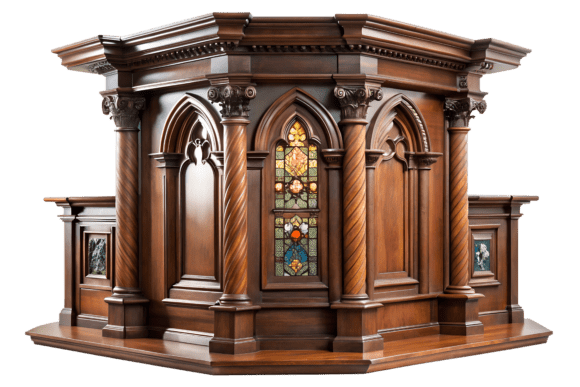
Ornate Wooden Pulpit with Stained Glass
A Design That Whispers Reverence—Not Shouts
First glance at Ornate Wooden Pulpit with Stained Glass isn’t about flash—it’s about presence. This Icons-category design carries a quiet, dignified weight: carved wood grain implied in subtle satin stitch, leaded stained glass panels suggested through careful color blocking and clean line work, and architectural symmetry that feels intentional, not ornamental for ornament’s sake. It doesn’t read like clip art. It reads like something you’d pause to admire in a sunlit chapel corner—then immediately imagine stitched onto a linen tea towel for a pastor’s anniversary gift or framed in an embroidered hoop for a seminary graduate’s nursery.
Where It Lives Best: Real Projects, Not Just Pixels
Last week, I prepped a custom order for a boutique church supply shop: ten cotton canvas tote bags for their annual retreat. They wanted something meaningful but not overtly doctrinal—elegant, timeless, and unmistakably handcrafted. Ornate Wooden Pulpit with Stained Glass landed perfectly. At 4.2" wide, it scaled cleanly on the tote’s front panel without crowding the handles or swallowing the fabric’s natural drape. The design’s vertical emphasis balanced the bag’s shape, and its moderate detail level held up beautifully in 30-weight rayon thread on medium-weight stabilizer. Customers didn’t just see “a pulpit”—they saw intention, care, and reverence translated into thread.
It also shines on baby embroidery: think a soft ivory knit onesie or a muslin pillow cover for a baptism gift. The stained glass motif reads as gentle color play—not religious dogma—but evokes light, hope, and sacred space in a way new parents appreciate. On sweatshirt embroidery? Yes—but only on structured, non-stretch fleece or French terry. The design’s fine lines and defined corners need stability; waffle-knit or ultra-soft blends risk blurring the stained glass effect.
Where It Asks for Thoughtful Handling
This isn’t a “throw-it-in-the-hoop-and-go” file. Its strength is also its caution: Ornate Wooden Pulpit with Stained Glass has delicate transitions—especially where wood grain meets glass panes—and small, high-contrast areas (like the narrow lead lines between colored sections) that can vanish on dark fabric or bleed on loosely woven textiles. On black twill caps? Possible—but only with heavy cutaway stabilizer, reduced stitch density in the glass zones, and a test run on scrap first. On thin cotton voile or stretchy jersey? Not advisable without significant redesign—those fine details will pucker or distort.
Also worth noting: the design’s visual balance relies on clear separation between elements. If your thread colors lack contrast (say, pale amber glass next to warm walnut wood), the stained glass illusion collapses. And while it works well as a standalone embroidery file, it’s not built for dense layering—avoid stacking it over topstitching or other busy background motifs. Let it breathe.
What It Adds to Your Finished Product—Beyond Aesthetics
Using Ornate Wooden Pulpit with Stained Glass elevates perceived value instantly. It signals craftsmanship—not just decoration. On Etsy listings, customers scroll past generic crosses or doves; they stop for this. Why? Because it feels curated, not mass-produced. It supports brand consistency for faith-based craft businesses: whether you’re selling personalized gifts, boutique nursery decor, or holiday embroidery kits, this design anchors your offerings in quiet sophistication.
It also builds trust. When a customer orders a custom embroidered apron for their church kitchen volunteer, seeing this design rendered cleanly in thread tells them you understand nuance—you’re not just running a machine, you’re interpreting meaning. That translates directly to repeat orders and word-of-mouth referrals among tight-knit communities.
Practical Designer Notes Before You Stitch
- Always test on scrap fabric—especially if using textured weaves, dark backgrounds, or lightweight knits.
- Check thread color contrast before hooping. Print a black-and-white mockup to verify legibility of glass panes and wood grain definition.
- Review stitch density. Some versions may pack too many fill stitches in the glass areas—adjust if needed to prevent stiffness or puckering.
- Confirm hoop size compatibility. This design fits comfortably in a 5x7 hoop, but verify your version’s dimensions before finalizing a production run.
- Inspect small details under magnification—especially the lead lines and corner joints. If they look fragile on screen, they’ll be fragile in thread.
- Use appropriate stabilizer: medium cutaway for stable wovens, tear-away for crisp linens, and heavy cutaway for knits or curved surfaces like caps.
- Verify licensing before selling finished items or bundling Ornate Wooden Pulpit with Stained Glass into digital product packs. Icons-category files often carry specific commercial-use terms—don’t assume.
Final Thought: A Quiet Anchor in a Noisy Market
In a landscape crowded with fast trends and flashy fonts, Ornate Wooden Pulpit with Stained Glass stands apart by doing one thing exceptionally well: holding space. It doesn’t try to be everything. It’s not a holiday-specific motif, nor does it shout for attention. Instead, it invites pause. For the Etsy seller building a cohesive collection of handmade products, it’s a signature piece. For the small shop owner curating meaningful merchandise, it’s a conversation starter. And for the embroidery designer who values clarity, structure, and emotional resonance in every stitch—it’s a reminder that sometimes, the most powerful designs are the ones that feel quietly inevitable.